- Home
- Government
- Departments
- Public Services
- Water Utilities
- Lead and Copper
Lead and Copper
On December 16, 2021, the EPA (Environmental Protection Agency) announced the next steps to strengthen the regulatory framework on lead in drinking water. The Lead and Copper Rule Revisions (LCRR) amend the Lead and Copper Rule. All community and non-transient non-community public water systems are required to comply with the LCRR starting October 16, 2024. The City has completed the lead service line inventory.
How the City of Rosenberg is Keeping Lead Out of Our Customer’s Water
The City of Rosenberg meets all of the EPA standards for lead in water and continues to be well below the state and federal action levels for lead. Rosenberg protects drinking water quality for all customers and actively minimizes any risk of lead. The City has a Superior Public Water System rating from the Texas Commission on Environmental Quality (TCEQ), which regulates metal contaminants, including lead and copper, in our drinking water.
Sources of Lead
There is no lead in the City of Rosenberg’s water source, the Gulf Coast Aquifer. There is also no lead in our treated drinking water. However, lead can enter water through corroding plumbing materials found in water service lines and home plumbing. Some common sources of lead can include pipes, solder, brass plumbing fixtures, faucets, and pipe fittings. These lead sources are more likely to be found in homes built before 1986. These lead sources are less common in Rosenberg than in many other major cities across the United States since Rosenberg stopped allowing lead pipes in private construction in 1986.
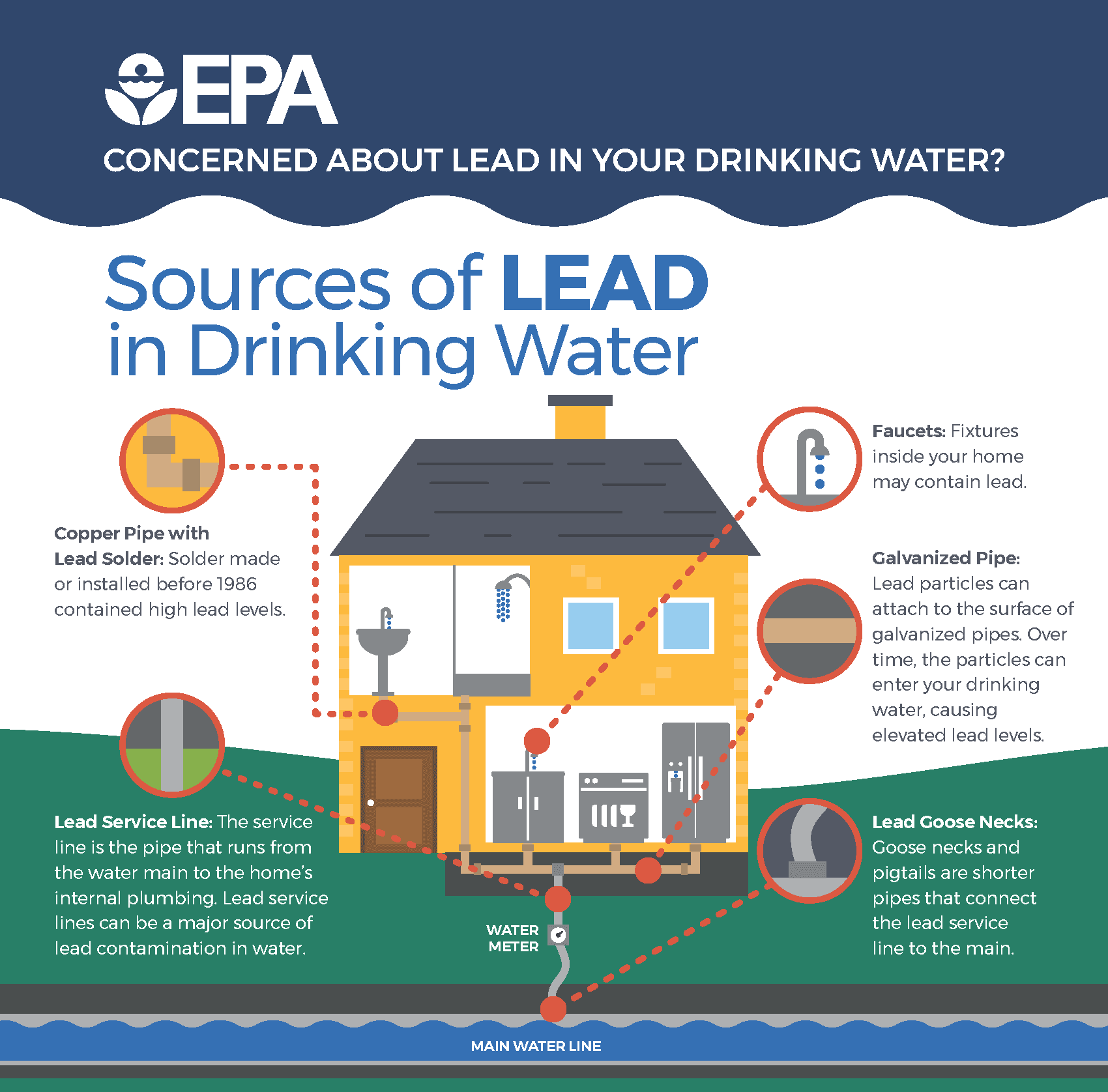
Lead Exposure Risk
Rosenberg utilizes ortho-polyphosphate at our treatment plants to aid with corrosion control. Over time, this addition has resulted in Rosenberg’s treated water forming a protective scale on the inside of pipes that prevents the leaching out of materials such as lead.
Understanding Your Water Service Plumbing
It is the shared responsibility of both the City of Rosenberg and property owners to protect from lead in drinking water. While there’s few potential lead sources, Rosenberg takes additional proactive steps to identify and replace lead piping. Nonetheless, Rosenberg is not responsible for the private piping inside your home up to your water meter.
What Rosenberg Is Doing to Comply with EPA’s Recently Adopted LCRR and to Eliminate Potential Public Lead Service Lines:
- Completed the lead service line inventory and submitted to TCEQ
- No lead service lines have been identified
- Preparing a plan for sampling water at all schools serviced by the City
- Preparing a plan for sampling water at all licensed daycares serviced by the City
- Preparing a plan for galvanized service lines needing replacement
If a galvanized service line needing replacement is found, the City will support customers in various ways to replace the line. This is a multi-year project, and the City will keep you updated on the progress being made.
How to Check Your Home
The City has created an interactive map that shows the results of the Water Supply Line Inventory. You can view the map by clicking here. If your home was identified as having a galvanized service line needing replacement, you will receive a direct notice from the City with detailed instructions regarding remediation steps needed.
Removing Lead Sources
Lead sources are often found on the property owner’s side of the meter. However, a good strategy to protect against lead is to identify and replace potential sources of lead on private property. A plumber can advise on the type of pipes in your home.
Testing and Minimizing Exposure
If you think your home’s plumbing and fixtures may contain lead, testing can identify whether lead has leached into your water. If the service line inventory provides evidence of high levels of lead in your service area, please call 832-595-3590 for more information and/or free testing.
TCEQ offers free sampling and analysis for lead in drinking water at schools and childcare facilities. Find out more here.
To reduce exposure to lead, you can also:
- Flush your home’s pipes by running the tap (1-2 minutes), doing laundry or doing a load of dishes
- Use only cold water for drinking or cooking
- Clean faucet screens or aerators
- Use a filter certified to remove lead
Information
Information on lead in drinking water, testing methods, and steps you can take to minimize exposure is available from the Safe Drinking Water Hotline at 800-426-4791 or epa.gov/safewater/lead.